





.jpg)


If you’ve followed the financial news lately, you’ve probably noticed that everyone seems to be talking about SpaceX.
The company has now been public for a little over a week, and the debut has certainly been impressive. Shares surged in the first few days of trading, briefly pushing the company near the top of the list of the world’s most valuable businesses. Even after some cooling off, the stock remains well above its IPO price, fueled in part by tremendous enthusiasm from retail investors.
And honestly, the excitement is understandable.
Innovative companies capture our imagination. They offer a vision of the future, and it’s only natural to wonder whether getting in early might lead to extraordinary returns.
But whenever a new stock becomes the talk of the investing world, I think it’s helpful to pause and ask a simple question:
What does history have to say?
As it turns out, history offers a perspective that is often very different from the headlines.
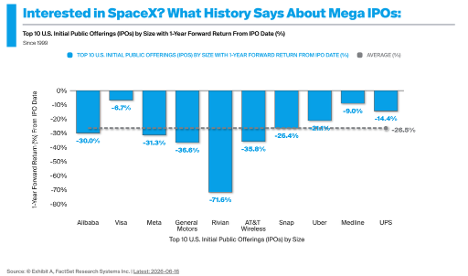
Looking at the ten largest U.S. IPOs since 1999, every single one produced a negative return during its first year as a public company. On average, investors lost more than 26% over that period.
That doesn’t mean every new public company is destined to disappoint. Far from it. Many eventually become fantastic businesses and rewarding long-term investments.
What it does suggest is that the excitement surrounding a company’s debut and the investment outcome that follows are not always the same thing.
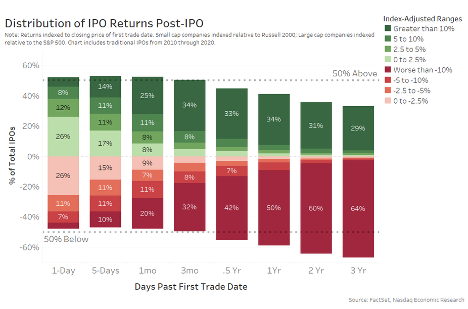
In fact, broader research on IPOs has found that while many experience a strong initial surge, nearly two-thirds trail their benchmark index within three years.
Why does this happen?
Often, it’s because the market quickly prices in years—even decades—of future success. Expectations become so high that even a great company canstruggle to live up to them.
That’s part of the challenge with investing in highly anticipated IPOs.You’re not just buying a business. You’re buying the expectations surrounding that business.
And expectations can be expensive.
Looking specifically at SpaceX, investors are currently paying a valuation that assumes remarkable future growth. The company may absolutely deliver on those expectations. It may even exceed them. But much of that success is already reflected in today’s price.
That’s not a prediction that the stock will rise or fall from here. Nobody knows.
Rather, it’s a reminder that investing success isn’t determined by finding the most exciting story. More often, it’s determined by maintaining discipline when everyone else is focused on excitement.
The market will always provide us with something new to chase. Twenty-five years ago it was internet companies. More recently it was cryptocurrencies, meme stocks, and artificial intelligence. Tomorrow it will be something else.
The challenge for investors isn’t identifying the next object of fascination. The challenge is staying focused on the long-term plan while everyone else is being pulled toward the latest headline.
Could SpaceX become one of the great corporate success stories of our generation? Absolutely.
Could it also remind investors that great companies and great investments are not always the same thing? Absolutely.
Whatever happens next, the investors most likely to succeed won’t be the ones who perfectly timed the excitement. They’ll be the ones who remained diversified, stayed patient, and allowed their financial plan—not the headlines—to guide their decisions.
As always, stay the course.


